
- English
- Español
- Português
- русский
- Français
- 日本語
- Deutsch
- tiếng Việt
- Italiano
- Nederlands
- ภาษาไทย
- Polski
- 한국어
- Svenska
- magyar
- Malay
- বাংলা ভাষার
- Dansk
- Suomi
- हिन्दी
- Pilipino
- Türkçe
- Gaeilge
- العربية
- Indonesia
- Norsk
- تمل
- český
- ελληνικά
- український
- Javanese
- فارسی
- தமிழ்
- తెలుగు
- नेपाली
- Burmese
- български
- ລາວ
- Latine
- Қазақша
- Euskal
- Azərbaycan
- Slovenský jazyk
- Македонски
- Lietuvos
- Eesti Keel
- Română
- Slovenski
- मराठी
- Srpski језик

TDR Cable Fault Locator: How Does It Work and Why Is It Essential for Accurate Cable Diagnostics
Finding faults in buried or wired cables traditionally involved destructive methods like digging along the entire length or cutting the cable. Today, the TDR Cable Fault Locator changes this entirely. Weshine provides advanced TDR Cable Fault Locator solutions that pinpoint fault locations non-destructively. The core technology relies on time-domain reflectometry, which sends a low-energy pulse down the cable and measures the time it takes to reflect from the fault.
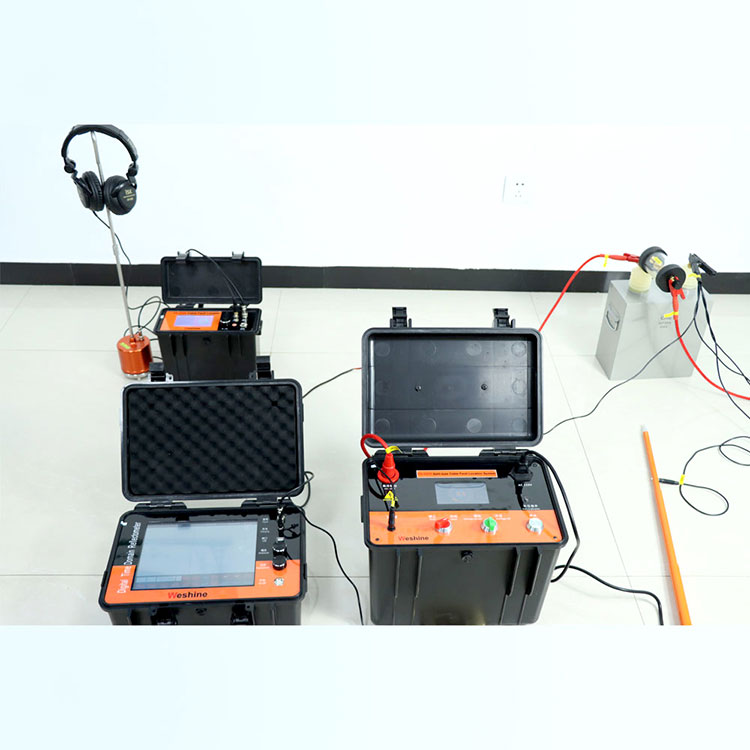
The Working Principle
A TDR Cable Fault Locator works like radar for cables. It launches a short-duration, low-voltage pulse into the cable. When the pulse encounters a change in impedance—such as an open circuit, short circuit, or water ingress—part of the pulse reflects back. The device measures the time between sending and receiving the pulse. Using the known velocity of propagation (Vp) for that cable type, it calculates the distance to the fault with the formula: Distance = (Velocity × Time) / 2.
| Feature | Benefit for Non-Destructive Testing |
|---|---|
| Low-energy pulses (5V to 24V) | No insulation breakdown or cable damage |
| High-speed sampling | Accurate fault location without re-testing |
| Adjustable Vp settings | Adapts to various cable materials |
| Reflection waveform display | Visual confirmation of fault type and distance |
Why No Damage Occurs
Unlike high-potential testers that stress insulation, the TDR Cable Fault Locator uses energy levels far below the cable’s withstand voltage. It does not require injecting high current or breaking the cable sheath. The measurement is passive from the cable’s perspective—only a brief, low-power signal is applied. Weshine engineering ensures that even sensitive data or communication cables remain unharmed during testing.
TDR Cable Fault Locator FAQ Common Questions
Question 1: Can a TDR Cable Fault Locator find faults on live cables?
Answer: Yes, many modern TDR Cable Fault Locator units, including those from Weshine, feature built-in filters that block 50/60 Hz power signals. This allows testing on low-voltage live cables up to 400V AC or DC without damaging the device or the cable. However, for safety and accuracy on high-voltage lines, the cable should be de-energized.
Question 2: What types of cable faults can a TDR Cable Fault Locator identify without cutting the cable?
Answer: A TDR Cable Fault Locator can identify open circuits, short circuits, splices, water or moisture ingress, crushed sections, and corroded connections. The reflection waveform displays a downward deflection for a short fault and an upward deflection for an open fault. It cannot measure resistive faults with very high resistance (above a few hundred ohms) without additional accessories like a high-voltage arc reflection filter, but standard low-resistance faults are easily located.
Question 3: How accurate is a TDR Cable Fault Locator for long cables over 1 km?
Answer: Accuracy depends on the velocity of propagation (Vp) setting and the device’s time-base precision. High-quality units like Weshine TDR Cable Fault Locator achieve ±1% of range or ±0.5 meters, whichever is greater. For a 2 km cable, this means error within 20 meters. Accuracy improves with proper Vp calibration using a known cable length. Environmental factors like temperature and cable aging can slightly affect Vp, so recalibration is recommended for critical measurements.
Practical Application Example
To measure a fault distance, an operator connects the TDR Cable Fault Locator to a single conductor and shield or ground. The device automatically sends pulses and displays the reflected waveform. The distance to the fault is read directly on screen. Weshine models include one-button auto-calibration and fault type recognition, reducing user error and testing time.
Contact Us
For expert guidance on selecting the right TDR Cable Fault Locator for your power, telecom, or industrial cables, contact Weshine today. Our team provides free application support, on-site demonstrations, and customized training for non-destructive cable fault location. Reach out via our website or email to request a quote or technical consultation.