
- English
- Español
- Português
- русский
- Français
- 日本語
- Deutsch
- tiếng Việt
- Italiano
- Nederlands
- ภาษาไทย
- Polski
- 한국어
- Svenska
- magyar
- Malay
- বাংলা ভাষার
- Dansk
- Suomi
- हिन्दी
- Pilipino
- Türkçe
- Gaeilge
- العربية
- Indonesia
- Norsk
- تمل
- český
- ελληνικά
- український
- Javanese
- فارسی
- தமிழ்
- తెలుగు
- नेपाली
- Burmese
- български
- ລາວ
- Latine
- Қазақша
- Euskal
- Azərbaycan
- Slovenský jazyk
- Македонски
- Lietuvos
- Eesti Keel
- Română
- Slovenski
- मराठी
- Srpski језик

What An Insulation Resistance Tester Does And How The VS-3127 Supports Field Testing
Insulation failure rarely announces itself. Moisture, contamination, heat, and ageing can gradually weaken the materials that separate energized conductors from one another and from ground. An insulation resistance test gives maintenance teams a practical way to check that barrier and track changes before they become harder to diagnose.
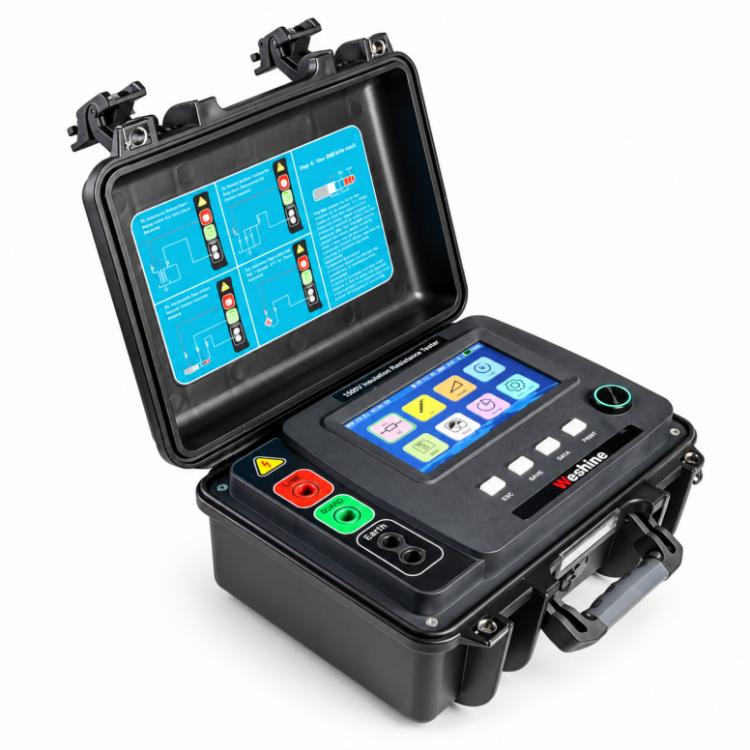
For field technicians, the tester matters as much as the test method. The voltage must suit the equipment, the reading must be clear, and the results need to be recorded in a way that supports later comparison. The Weshine VS-3127 brings a 10 kV output range, six test modes, waveform display, and onboard data management into one portable instrument.
A Broader View of Insulation Condition
An insulation resistance tester, often called a megohmmeter, applies DC voltage to a test object and measures the resulting current. It calculates resistance using Ohm’s law:
R = V / I
The measured current changes during a test as the test object charges and the insulation responds to the applied voltage. A single reading can provide a useful snapshot, while timed readings show how resistance changes throughout the test.
The VS-3127 is designed to support both routine checks and more detailed field diagnostics. Its test voltage can be selected from fixed settings of 100 V, 250 V, 500 V, 1 kV, 2.5 kV, 5 kV, and 10 kV, or adjusted from 50 V to 10 kV. Test duration is adjustable from 10 seconds to 99 minutes, with short-circuit current settings from 1 mA to 6 mA.
At the 10 kV setting, the manual specifies a full-scale resistance of 20 TΩ. Resistance accuracy varies by range: the stated accuracy is ±5% in the lower portion and ±20% in the upper portion of each range. Output-voltage accuracy is specified as ±10%. These details help users match the tester to the application and understand the limits of a reading when comparing results.
More Than a Single Resistance Reading
A spot reading is commonly recorded after a set interval, often one minute. It is useful for routine checks and trending when test conditions remain consistent. Timed measurements add context by showing how resistance develops over time.
The VS-3127’s IR mode can calculate the Polarization Index (PI) and Dielectric Absorption Ratio (DAR). DAR can be set to R60s/R15s or R60s/R30s; PI uses readings at 10 minutes and 1 minute when the test duration allows. These ratios can help characterize insulation response, but they are not universal pass/fail criteria. Their interpretation depends on the asset, insulation system, and applicable procedure.
For further analysis, the instrument offers step-voltage (SV), ramp-voltage (RAMP), and dielectric-discharge (DD) modes. SV testing applies voltage in five stages and records resistance at each level. RAMP increases voltage at a selected rate from 100 V/min to 2,000 V/min while tracking the response. DD captures discharge behavior after the test. Used appropriately, these modes give technicians more information than a basic resistance value alone.
The tester also includes a dedicated metal-oxide arrester (MOA) mode, which measures parameters including U1mA and R500V. Its VOLT mode monitors AC or DC voltage and frequency, and warns when voltage is detected. This is a useful check before insulation testing, when confirming that the test object has been properly isolated.
Designed for Field Work
High-voltage testing often takes place in substations, industrial plants, cable tunnels, and outdoor equipment areas. The VS-3127 combines a 7-inch color touch display with a rotary control, allowing technicians to set test parameters and review results at the instrument. During a test, the screen can display voltage, current, and resistance waveforms so the measurement can be followed as it develops.
Data handling is built into the same workflow. The Weshine VS-3127 stores at least 512 test records with timestamps and user-entered equipment IDs. Bluetooth and USB support data transfer, while compatible mobile app and PC software provide remote operation, record retrieval, and report export, according to the manual. For teams managing repeated inspections, keeping the settings and results together can make follow-up comparisons more straightforward.
The built-in 16.8 V, 4,000 mAh lithium battery supports portable operation. The manual specifies approximately five hours of operation during a 10 kV test with a 100 MΩ load. The stated operating temperature is -10°C to 50°C, with relative humidity below 85% and no condensation.
After a test, capacitive loads are discharged automatically and the discharge status is displayed. The specified discharge rate from 10 kV to 50 V is no more than 0.47 seconds per microfarad. Discharge time depends on the test object and conditions; users should verify that the voltage has fallen to a safe level before handling leads or terminals.
Applying the Test to a Transformer
Transformer insulation resistance testing can establish a baseline and help identify significant changes. A common sequence measures insulation between the high-voltage and low-voltage windings, from the high-voltage winding to ground, and from the low-voltage winding to ground. The exact connections depend on transformer design and the applicable procedure.
Before connecting the tester, isolate and de-energize the transformer, confirm it is safe to test, and prepare clean, dry terminals. Record the test voltage, duration, winding connections, temperature, and resistance. Compare the result with previous measurements taken under similar conditions.
Temperature can affect insulation resistance, so comparisons are more useful when measurements are taken at similar temperatures or corrected using a method appropriate to the asset. The VS-3127 supports temperature conversion based on oil temperature for oil-immersed transformer testing. This can help organize comparisons, but the correction method should still follow the transformer’s test procedure.
Choosing the Right Tester and Reading the Result
Handheld instruments are often used for routine checks on smaller equipment. Industrial high-voltage testers are used for assets such as transformers, cables, motors, and switchgear, while benchtop instruments serve controlled laboratory and production environments. Selection should be based on required test voltage, resistance range, accuracy, safety functions, and the test object.
Resistance is expressed in ohms (Ω), though insulation testers typically display megohms (MΩ), gigohms (GΩ), or teraohms (TΩ). One GΩ equals 1,000 MΩ, and one TΩ equals 1,000 GΩ. A higher reading generally means less current passed through the insulation under the test conditions, but it does not by itself prove that equipment is fit for service. A sudden decrease, unstable result, or imbalance between comparable windings merits investigation.
Standards also need to be applied within their intended scope. IEEE 43 addresses insulation resistance testing of electric machinery, including rotating-machine windings; IEEE SA currently lists IEEE 43-2013 as inactive-reserved and identifies P43 as a current project. IEC 60076-3 covers insulation requirements and dielectric tests for power transformers, rather than serving as a universal table of minimum insulation resistance values. ANSI/NETA ATS-2025 provides acceptance-testing specifications for electrical power equipment and systems. Use the applicable edition together with project requirements and manufacturer guidance. IEEE SA, IEC 60076-3, ANSI/NETA ATS
A Practical Instrument for Insulation Testing
The VS-3127 combines selectable test voltage, timed IR testing, SV and RAMP analysis, DD testing, MOA measurement, voltage monitoring, and field data management. For maintenance teams, that combination can reduce the need to carry separate instruments for each of these tasks and make it easier to capture test conditions alongside results.
Its value depends on using the right mode and settings for the asset. Technicians should follow the equipment manufacturer’s instructions, the Weshine tester manual, and site safety procedures, including isolation, discharge, grounding, and verification before handling connections. With those practices in place, the VS-3127 can support consistent insulation checks and more useful records for ongoing maintenance.